


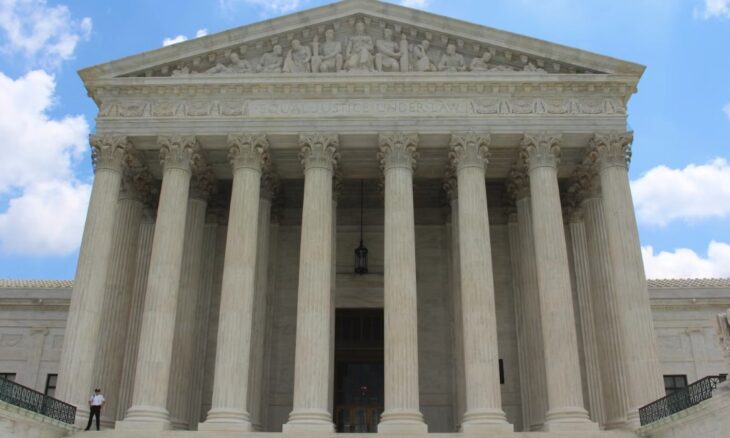
Public Confidence, Institutional Limits, and Civic Responsibility.
PRAY FIRST for wisdom among citizens and leaders alike and that we may appreciate institutions not by partisanship but by their role in fostering peace and justice.
Blessed are the peacemakers, for they shall be called sons of God. Matthew 5:9
In the U.S., the Supreme Court holds a unique place: a body with the final word on constitutional questions, yet one without an army or enforcement power of its own. Its authority rests not on ballots or budget, but on the trust of the people and the respect of co-equal branches. That trust has profound implications far beyond individual rulings. Understanding the Court’s role beyond decisions helps clarify both its constitutional design and its fragile place in civic life.
The Supreme Court does more than decide cases. It interprets the Constitution, shapes legal doctrine, and provides stability to the rule of law. Through judicial review—the power to assess whether laws align with the Constitution—the Court stands as a check on the other branches. This structure is rooted in constitutional intent: Article III establishes a separate judiciary, and protections like life tenure and salary security ensure independence from political pressure. Such independence was envisioned to allow judges to decide impartially on matters of law without fear or favor.
This structural design means the Court has no enforcement power. It cannot compel the President or Congress to act, nor does it implement its own rulings. Its influence depends on persuasion and legitimacy, the willingness of other branches and the public to recognize its authority. Alexander Hamilton described this concept in Federalist No. 78, observing that the judiciary “as no influence over either the sword or the purse” and must rely on judgment alone.
Independence, then, was not an incidental benefit but essential. By shielding judges from political retaliation, the Constitution set out to foster a judicial system capable of withstanding temporary majorities and preserving long-term legal coherence.
Legitimacy and Public Confidence
If legitimacy—broadly understood as public confidence that the Court is fair, impartial, and grounded in law—erodes, the Court’s authority weakens. Recent research shows exactly that trend: trust in the Supreme Court and federal courts has declined sharply over the last two decades. A long-term study found that Americans expressing “a great deal” or “a fair amount” of confidence in the judiciary dropped from about 75 percent in 2000 to under 50 percent by 2022.
Perceptions of bias or partisanship contributed to this decline. Surveys indicated many Americans now question whether justices set aside personal views to decide cases on legal grounds, and disapproval often spikes after controversial decisions.
Importantly, legitimacy is different from agreement with any specific ruling. A court retains legitimacy when people understand its role, see its decisions as based on legal reasoning, and believe outcomes reflect consistent principles rather than fleeting political winds. Studies of judicial acceptance show that even those who disagree with particular outcomes may still view the institution as legitimate if they perceive fair procedures and connection in decisions.
Institutional Limits and Accountability
The Supreme Court’s authority is not unlimited. The Constitution and laws set several formal constraints. Congress and the president share powers that influence the Court—the president nominates justices, the Senate confirms them, and Congress determines the structure of the federal judiciary. These systems balance judicial independence with democratic accountability.
Precedent, which is the practice of respecting earlier decisions, also shapes the Court’s work. While the Court can overturn past rulings, it typically does so cautiously, acknowledging that stability in the law nurtures public confidence and allows citizens to plan their lives with some predictability.
At times, long-standing doctrinal interpretations may be reconsidered, especially when societal understandings shift. However, such changes weigh heavily against the risk of appearing random or politically motivated.
The Court in Civic Life
Public perception of the Supreme Court is influenced significantly by media coverage and civic education. Simplistic or sensational reporting can skew understanding of complex legal reasoning, while deeper explanations of how constitutional interpretation works rarer. Civic institutions, educators, and journalists all play vital roles in helping citizens grasp not only the “what” of rulings, but the “why” behind them, as well as why those reasons matter. This deeper engagement helps people see the Court not as an arena for partisan victory but as an institution shaped by specific responsibilities and limits.
Citizens also have a role. Thoughtful engagement with judicial decisions—including learning about the Constitution, civil law, and separation of powers—can support a more informed public conversation. This engagement does not require agreement with specific outcomes, but it does encourage respect for processes that preserve the rule of law.
Why It Matters and How We Can Respond
A stable judiciary helps anchor a functioning democracy. When trust falters, so does confidence in the law’s ability to protect rights and resolve disputes peacefully. As believers, this resonates with a deeper conviction about the orderliness of justice. Scripture reminds us that “the king’s heart is a stream of water in the hand of the Lord; he turns it wherever he will,” which is a reminder that earthly authorities, including judges, ultimately act within God’s sovereign authority (Proverbs 21:1).
Public confidence in institutions is not a given; it must be nurtured through humility, truthfulness, and care in how we respond. We can approach discussions about the Court not as spectators but as citizens committed to clarity over cynicism and constructive dialogue over dismissal. We are called to pray for those in positions of authority—including judges—that they may “lead a peaceful and quiet life, godly and dignified in every way” (1 Timothy 2:2).
HOW THEN SHOULD WE PRAY:
— Pray for those who serve on the Supreme Court and in other judicial roles, that they would exercise judgment with humility and steadfast allegiance to truth. The integrity of the upright guides them, but the crookedness of the treacherous destroys them. Proverbs 11:3
— Pray for God to give our nation’s leaders renewed civility and clear communication in public discourse around judicial issues, helping others see complex issues without fear or distortion. The heart of the righteous ponders how to answer. Proverbs 15:28
CONSIDER THESE ITEMS FOR PRAYER:
- Pray that leaders across the Administration, Congress, and the Judiciary cultivate hearts that listen before speaking to foster humility, patience, and genuine understanding in every civic conversation.
- Pray for God’s truth to pierce through confusion, distortion, and the haste of public judgment, bringing clarity, wisdom, and discernment to our nation.
- Pray for each judge’s heart to be shaped by God and guided by His righteousness, and aligned with His perfect will in every decision they render.
Sources: U.S. Courts, Federal Judicial Center, The Constitution Center, Annenberg Public Policy Center of the University of Pennsylvania
RECENT PRAYER UPDATES